


Cast Iron New York Strip Steak (Perfect Steakhouse Method)
This post may contain affiliate links.


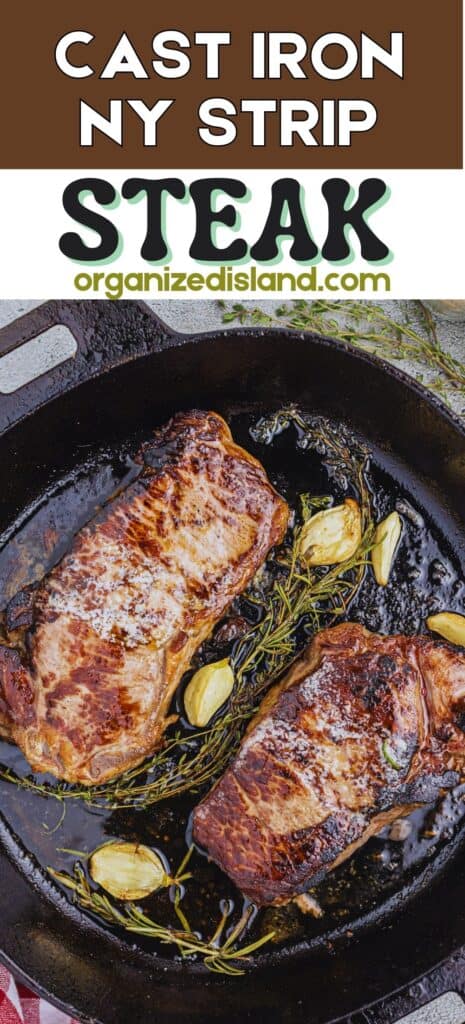

This cast iron New York strip steak is my go-to when I want a steakhouse dinner at home without firing up the grill. A very hot cast iron skillet gives you a deep golden crust, and a quick garlic herb butter baste keeps the inside juicy and tender. You only need a handful of ingredients, and the steak cooks in about 10 minutes. If you love this method, try my Cast Iron Ribeye next.
Like my Cast Iron Ribeye, the awesome part about cooking a Cast Iron New York Strip steak is that you really don’t need a ton of ingredients to give it flavor.

Why This pan seared new york strip Works
I used to be nervous about cooking steak at home, but this method changed that, and now I love cooking steak. It’s hard to mess up. A properly preheated cast iron skillet does the heavy lifting by holding steady, high heat for a restaurant-style crust. The butter baste at the end adds rich garlic and herb flavor without any risk of burning. A thermometer takes the guesswork out of doneness, so you get the exact result you want every time.
Recipe Highlights

Not only is this great for a night in but it’s also fun for holidays and a special date night at home, too. Because when you can cook a steak this good, why go elsewhere and pay a ton of money for one?
INGREDIENTS FOR THIS CAST IRON NEW YORK STEAK

- Boneless New York strip steaks, 3/4 to 1 inch thick – Get them thick-cut by the butcher.
- Oil: Use avocado oil or light olive oil. Both handle high heat without burning.
- Butter – I like to use salted butter for this recipe.
- Cloves garlic, peeled and smashed
- Kosher salt and black pepper: Season generously. Coarse salt helps build the crust.
- Fresh herbs: 1 sprig of rosemary and 4–5 sprigs of thyme.
Equipment
Cast Iron pan – this Lodge Pan is a great one.
HOW TO MAKE THIS CAST IRON NEW YORK STRIP
Step 1: Dry, season and rest. Pat the steaks completely dry with paper towels, because moisture is the enemy of a good crust. Season every side generously with kosher salt and coarse black pepper, including the edges. Let the steaks sit at room temperature for 30 minutes while you prep your sides.
Step 2: Get the skillet very hot. Set your cast iron skillet over medium-high heat and let it preheat for a full 5 minutes. Add the oil. When it shimmers and you see the first wisp of smoke, you’re ready. Turn on your vent hood now.
Step 3: Sear without touching. Lay the steaks in the skillet, placing them away from you so the oil doesn’t splatter toward you. You should hear a loud sizzle right away. If you don’t, take them out and give the pan another minute. Leave the steaks alone for about 4 minutes so a deep golden-brown crust can form. Once the crust is ready, the steaks will release from the pan on their own.
Step 4: Flip once and render the edge. Flip the steaks and cook for 2 minutes. Then use tongs to stand each steak on its fat-cap edge for 30–60 seconds. This renders the fat strip that runs along every New York strip, so it turns crispy instead of chewy.
Step 5: Baste with garlic herb butter. Lower the heat to medium and add the butter, smashed garlic, rosemary and thyme. When the butter foams, tilt the skillet toward you and keep spooning the butter over the steaks for 1–2 minutes. Start checking the temperature now. For medium-rare, pull the steaks at 125°F.
Step 6: Rest, then slice. Move the steaks to a cutting board and spoon the garlic butter from the pan over the top. Let them rest for 5–10 minutes so the juices settle back into the meat. Slice against the grain and serve.
Cooking a thick-cut steak? For steaks 1½ inches or thicker, follow Steps 1–5. Then put the whole skillet in a 400°F oven for 4–10 minutes, depending on thickness, until the steaks reach their pull temperature. Use the cook time chart below as your guide. Use an oven mitt, because the handle will be extremely hot.

Recipe Tips
- Choose the right steak. Look for New York strips that are bright red with even marbling and a uniform thickness, ideally ¾ to 1¼ inches. Steaks that are thinner at one end cook unevenly. Ask your butcher to cut them to the thickness you want.
- Don’t skip the room-temperature rest. A steak straight from the fridge can burn on the outside before the center cooks. Thirty minutes on the counter makes a noticeable difference.
- Use a high-smoke-point oil. Avocado oil or light olive oil can take the heat without burning. Save the butter for the end. If it goes in at the start, it scorches.
- Flip only once. Leaving the steak alone is what builds the crust. If it sticks when you try to flip it, wait another 30–60 seconds.
- Don’t crowd the pan. A 12-inch skillet fits two strip steaks comfortably. If you add a third, the pan cools down and the steaks steam instead of sear, so cook in batches if you need to.
- Trust the thermometer, not the clock. Every stove and every steak is a little different. An instant-read thermometer is the easiest way to get the doneness you want every time.
- Rest before slicing. If you cut in right away, the juices run out onto the board. Five to ten minutes of resting keeps the steak juicy.
- Make a quick pan sauce. While the steaks rest, add a sliced shallot to the leftover garlic butter and cook it over medium-low for 3–4 minutes. Pour in ¼ cup of beef broth or red wine and scrape up the browned bits. Let it bubble for 1 minute, then spoon the sauce over the sliced steak.
Steak Doneness Temperature Chart
An instant-read thermometer is the most reliable way to cook a New York strip exactly how you like it. Insert it from the side into the thickest part of the steak, avoiding the fat. Pull the steak about 5°F before your target temperature, because it keeps cooking as it rests.
| Doneness | Pull From Pan | Final Temp After Rest | What It Looks Like |
|---|
| Rare | 115–120°F | 120–125°F | Cool, bright red center |
| Medium-Rare | 125°F | 130–135°F | Warm, red-pink center |
| Medium | 135°F | 140–145°F | Warm, pink center |
| Medium-Well | 145°F | 150–155°F | Slightly pink center |
| Well Done | 155°F | 160°F+ | No pink |
Cook Time by Thickness
These times are for medium-rare in a cast iron skillet preheated over medium-high heat. Use them as a guide and let your thermometer make the final call.
| Steak Thickness | First Side | After Flipping | Oven Finish (400°F) | Approx. Total |
|---|---|---|---|---|
| ¾ inch | 3 min | 2 min | Not needed | 5 min |
| 1 inch | 4 min | 2–3 min | Not needed | 6–7 min |
| 1¼ inch | 4–5 min | 3–4 min | Not needed | 8–9 min |
| 1½ inch | 4 min | 2 min | 4–6 min | 10–12 min |
| 2 inch | 4 min | 3 min | 8–10 min | 15–17 min |
For medium, add about 1–2 minutes. For medium-well or well done, finish thicker steaks in the oven so the crust doesn’t burn before the center cooks through.
FAQ
How long do you cook a New York strip in a cast iron skillet?
For a 1-inch New York strip cooked to medium-rare, sear it for about 4 minutes on the first side and 2–3 minutes on the second, including the butter baste. That’s about 6–7 minutes total over medium-high heat. Thinner steaks need less time. Steaks 1½ inches or thicker should finish in a 400°F oven. Use an instant-read thermometer and pull the steak at 125°F for medium-rare.
Should you use butter or oil to cook steak in cast iron?
Use both, at different times. Start with a high-smoke-point oil like avocado oil or light olive oil, because it can handle the high heat needed for a good sear. Add butter only during the last 1–2 minutes and use it to baste the steak with garlic and herbs. If you add butter at the start, it burns before the steak is done.
How often should you flip a steak in a cast iron skillet?
For this method, flip it once. Leaving the steak undisturbed for the first 4 minutes is what builds the deep brown crust. Constant flipping can work, but it takes more attention, and flipping once gives reliable results every time. If the steak sticks when you try to flip it, the crust isn’t ready yet, so give it another 30–60 seconds.
What is the 3-3-3 rule for steak?
The 3-3-3 rule is a popular shortcut: sear the steak for 3 minutes on the first side, 3 minutes on the second side, then rest it for 3 minutes. It’s a decent starting point for a 1-inch steak cooked to about medium-rare. Steak thickness and stoves vary a lot, though, so a thermometer is more reliable. Resting closer to 5–10 minutes also keeps the steak juicier.
What is a New York strip steak?
A New York strip is cut from the short loin, the muscle just behind the ribeye. You may also see it labeled as strip steak, strip loin, top loin or Kansas City strip. It’s leaner than a ribeye, with a firm, beefy texture and a strip of fat along one edge. Rendering that fat in the skillet makes it crisp and full of flavor.
Do you need to marinate a New York strip steak?
No. A good New York strip only needs kosher salt, black pepper and the garlic herb butter at the end. If you’d like extra flavor, try my Steak Marinade for 2–8 hours. Pat the steak completely dry before searing, because a wet steak won’t brown.
Can I use a different cut of steak?
Yes. This method works well with ribeye, sirloin and filet mignon. Ribeye has more marbling and may need an extra minute. Filet mignon is usually cut thick, so finish it in a 400°F oven. Whatever cut you use, cook to temperature rather than time.
How do you store and reheat leftover steak?
Refrigerate leftover steak in an airtight container for up to 3–4 days. To reheat without overcooking, warm it in a 250°F oven until just heated through, about 15–20 minutes. You can also slice it thin and serve it cold on salads or in sandwiches. Cooked steak can be frozen for 2–3 months, though it will be slightly drier once thawed.
CAST IRON NEW YORK STEAK
Don’t forget to bookmark this recipe.

What to Serve with New York Strip Steak
New York strip pairs well with classic steakhouse sides:
Toppings: Cilantro Chimichurri or a pat of Jalapeño Butter melted over the hot steak
Potatoes: Parmesan Smashed Potatoes, Roasted Smashed Potatoes, Crispy Potato Wedges or Old Fashioned Scalloped Potatoes
Veggies: Grilled Asparagus or a crisp wedge salad with Steakhouse Blue Cheese Dressing
Comfort sides: Old Fashioned Baked Mac and Cheese and Texas Roadhouse Rolls
Storage Suggestion
Keep leftovers in an airtight container in the fridge for 3–4 days. To reheat, warm slices in a 250°F oven until just heated through, or slice thin and use cold in salads. Cooked steak can be frozen for 2–3 months, but it comes out a little drier once thawed.
More Steak and BBQ Recipes
Steak Marinade – This marinade is perfect for steaks too!
Easy Homemade Teriyaki Sauce – Rich and flavorful and great with chicken, beef or fish.
Grilled Beef Skewers The perfect beef dish to use this marinade! Absolutely delicious!

Cast Iron New York Strip Steak
Equipment
- 12-inch cast iron skillet
- Instant-read meat thermometer
- Large spoon (for basting)
Ingredients
- 3 New York strip steaks (boneless , 3/4 to 1 inch thick_ (about 2 ½ pounds total)
- 2 teaspoons kosher salt
- 1 teaspoon coarse black pepper
- 2 tablespoons avocado oil or light olive oil
- 3 tablespoons salted butter
- 4-5 sprigs fresh rosemary
- 1 bunch fresh thyme
- 3 cloves garlic, peeled and smashed
Instructions
- Season and rest. Pat the steaks very dry with paper towels. Season all sides generously with salt and pepper. Let them sit at room temperature for 30 minutes.
- Heat the skillet. Heat the cast iron skillet over medium-high heat for about 5 minutes, until very hot. Add the oil. The pan is ready when the oil shimmers and just starts to smoke
- Sear the first side. Lay the steaks in the pan, placing them away from you. Leave space between them, and cook in batches if your skillet is crowded. Sear without moving them for 4 minutes, until a deep brown crust forms and the steaks release easily.
- Flip once. Flip the steaks and cook 2 minutes. Use tongs to hold each steak on its fat-cap edge against the pan for 30–60 seconds to render the fat.
- Butter baste. Lower the heat to medium. Add the butter, garlic, rosemary and thyme. Tilt the skillet toward you and spoon the foaming butter over the steaks continuously for 1–2 minutes. Stop when the thermometer reads 5°F below your target doneness (125°F for medium-rare).
- Rest. Move the steaks to a cutting board and spoon the garlic butter over the top. Rest them for 5–10 minutes. The temperature will rise about 5°F as they rest.
- Slice and serve. Slice against the grain and serve with the pan butter spooned over the top.
Notes
- ¾ inch: 3 minutes on the first side, then 2 minutes after flipping
- 1 inch: 4 minutes on the first side, then 2–3 minutes after flipping, including the baste
- 1½ inches or thicker: Sear both sides and baste, then move the skillet to a 400°F oven for 4–6 minutes. Take it out when the steak reaches its pull temperature.
-
Doneness (pull temperature → final temperature after resting):
- Rare: pull at 115–120°F → 120–125°F
- Medium-rare: pull at 125°F → 130–135°F
- Medium: pull at 135°F → 140–145°F
- Medium-well: pull at 145°F → 150–155°F
- Well done: pull at 155°F → 160°F and up
Nutrition
If you are not yet subscribing to my CELEBRATE THE SEASON newsletter, you can subscribe here. I share a few things that I don’t share here and I email you only once a week. I know how valuable your time is and respect that tremendously!
Oh, my! The butter! The rosemary and thyme! What a winning recipe. I love a good steak but I’ve never attempted it.
The butter really adds a nice flavorful touch!
This is such a winning recipe!
This tasted so amazing! Thanks a lot for sharing this super easy to make steak recipe! Fam really loves it! Will surely have this again! Highly recommended!
At what point are you supposed to put the steak into the oven? What temperature? How long?
Hi Nick,
Thanks for visiting and you are right that we could do a little better with the direction on that. I have updated the recipe card to answer your questions.
I don’t have a thermometer. My desired done-ness is medium rare. Can you provide guidance on if this changes the amount of time on the stove or in the oven? Thanks!
Roast until internal temperature of steak is 125° for rare, 135° for medium rare, and 145° for medium, about 8 to 10 minutes (if you don’t have a thermometer).